
The "Who Pays?" Guide for Home Care
Navigating the Costs of Quality Care in the Bay Area
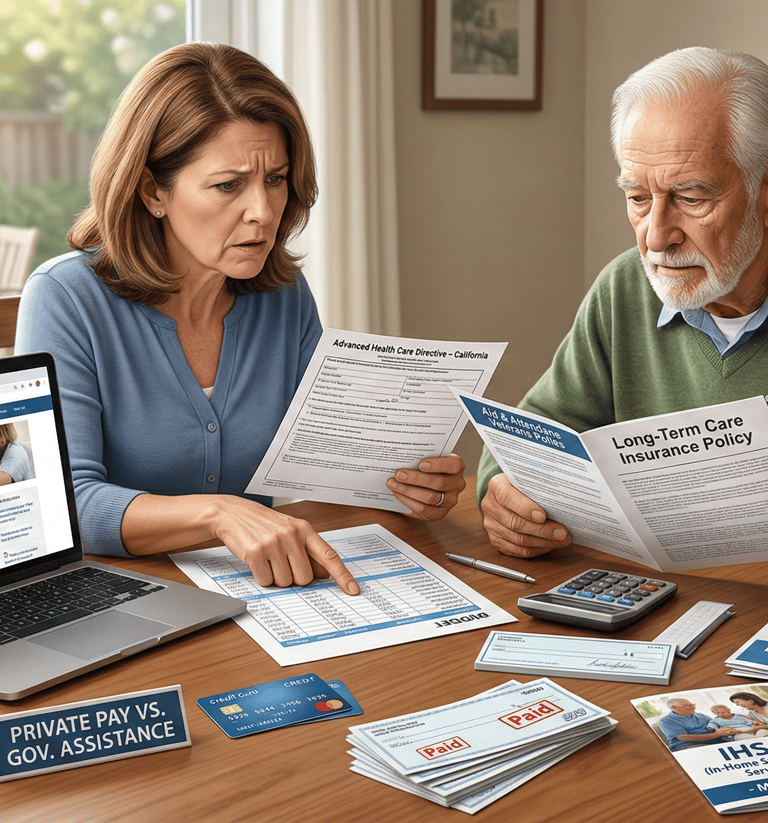
When a loved one needs help at home, the financial landscape can be overwhelming. In the Bay Area, where the average cost of home care ranges from $35 to $45 per hour, it is essential to understand which programs help—and which do not.
Private Pay (Out-of-Pocket)
For the majority of families in the Peninsula, non-medical home care is a "Private Pay" service. This means the family uses savings, pensions, or income to pay for services directly.
Local Rates: In the Bay Area, average agency rates currently sit between $35.00 and $45.00 per hour. Specialized care (Dementia or Parkinson’s) may command a higher premium.
Flexibility: Private pay allows you to start care immediately, choose your own hours, and select a specific agency without government waitlists or restrictive medical requirements
Long-Term Care Insurance (LTCI)
If your loved one has a Long-Term Care Insurance policy, it can be a lifesaver. However, these policies have specific "triggers" before they pay out.
The Trigger: Most policies require that a senior needs help with at least two Activities of Daily Living (ADLs)—like bathing, dressing, or transferring—or has a cognitive impairment.
Elimination Period: Be aware of the "waiting period" (often 30, 60, or 90 days) where you must pay for care out-of-pocket before the insurance company begins reimbursement.
The Agency Benefit: Most LTCI policies require that care be provided by a licensed home care agency. They often do not pay for private "under-the-table" hires.
Veterans Benefits (Aid & Attendance)
Wartime veterans and their surviving spouses may be eligible for a monthly pension "add-on" called Aid and Attendance.
Benefit Levels: For a single veteran requiring aid and attendance, the benefit can provide up to $2,424 per month tax-free to help pay for home care. A surviving spouse can receive up to $1,558 per month.
Requirement: The veteran must have served at least 90 days of active duty, with at least one day during a wartime period, and meet specific financial and medical criteria.
Medi-Cal (California’s Medicaid)
Medi-Cal is designed for low-income seniors, but California has unique programs that help seniors stay at home rather than moving to a nursing facility.
IHSS (In-Home Supportive Services): This is the primary Medi-Cal program that pays for home care. It allows eligible seniors to hire a caregiver (including a family member) to help with chores and personal care.
Asset Test: As of January 1, 2026, California has reinstated asset limits for Medi-Cal. To qualify, an individual can have no more than $130,000 in countable assets ($195,000 for couples).
Note: Licensed private-pay agencies (like most in the Peninsula) typically do not accept direct Medi-Cal payments, though some families use IHSS hours to "supplement" private care.
What About Medicare?
This is the most common misconception in senior care.
The Reality: Medicare does not pay for non-medical home care (bathing, cooking, cleaning).
The Exception: Medicare only pays for "Home Health" (skilled nursing or physical therapy) on a short-term basis after a hospital stay. Once the patient is stabilized, Medicare coverage ends.